AI marketing agents in 2026: automation versus autonomy
AI marketing agents are driving 40% cost savings and 83% revenue growth in 2026. How the shift to agentic AI changes campaign execution for brands.

For the last three years, the marketing industry’s relationship with artificial intelligence has basically been: prompt and wait. You ask a large language model to write a brief, it writes a brief. You ask an image generator for a storyboard, it gives you a storyboard. The human remained the operator; the AI was the tool.
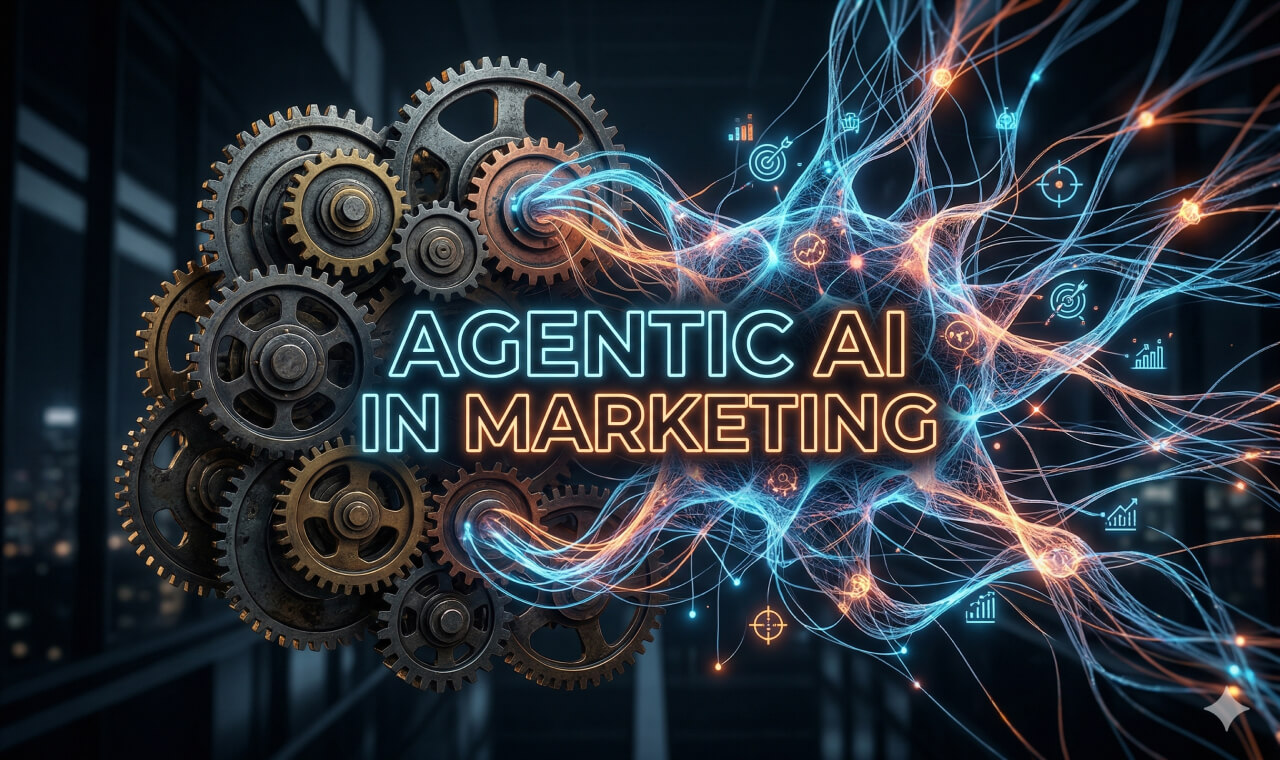
In 2026, that architecture is breaking apart. We are watching the transition from AI as a tool to AI as an agent.
The distinction matters. A tool does what you tell it to do. An agent understands the goal you want to achieve, formulates a plan to get there, interacts with other software systems to execute the plan, and measures the result — largely without you.
If you are a media planner, a performance marketer, or a CMO, the arrival of agentic AI is not just another software update. It is the restructuring of how a marketing department actually functions. And the adoption curve is steeper than anything we saw during the generative AI boom of 2023, even as general AI adoption remains slower than expected in other sectors.
The numbers behind the agentic shift
By the end of 2026, 40% of enterprise applications will embed task-specific AI agents, up from fewer than 5% in 2025, according to projections circulating in March 2026. The average enterprise is expected to deploy 20 distinct AI agents across its operations over the next two years.
The reason the adoption is this aggressive is that the ROI is measurable in weeks, not years.
Current data shows organizations reporting 40% operational cost savings through AI agent deployment. Teams utilizing AI-powered lead qualification agents are seeing 83% revenue growth, compared to 66% for those still relying on manual or rules-based automation. In specific B2B use cases, autonomous lead scoring has driven a 5x improvement in conversion rates.
Marketing teams heavily utilizing these agents are saving an average of 14.8 hours per week per employee. For a mid-sized agency, that is not an efficiency gain — that is a margin transformation.
Automation vs. Autonomy
To understand why agents are different from the marketing automation we have had for a decade, look at media buying.
Traditional marketing automation is rules-based. If the ROAS drops below $2.50, then pause the campaign. If the user abandons the cart, then send email sequence B. The human has to predict every possible scenario and write a rule for it. If the market does something unpredictable, the automation fails.
Agentic marketing is goal-based. The instruction is: Maximise qualified leads from the healthcare sector while keeping CAC under $45. The agent then monitors the live campaigns across Meta, Google, and LinkedIn. It notices that creative variant C is underperforming on LinkedIn but converting cheaply on Meta. It autonomously shifts budget to Meta, generates a new variant of creative C tailored for healthcare, launches it on LinkedIn to test against the control, and reports back on the outcome.
The agent doesn’t need a rule for every scenario. It understands the objective and adjusts its strategy to hit it. It is the difference between setting an alarm clock and hiring an assistant.
The collapse of campaign timelines
The immediate impact of agentic AI is speed.
In a traditional agency model, campaign optimisation happens in cycles. Data is pulled on Monday, analysed on Tuesday, discussed with the client on Wednesday, and adjustments are made on Thursday. That cycle is necessary because human analysis takes time, and translating analysis into action across multiple platforms requires coordination.
An AI marketing analytics agent completes that entire loop in seconds, continuously, 24 hours a day.
This is why businesses adopting these agents are seeing a 30% improvement in cost-per-acquisition. They are not necessarily making better decisions than a brilliant human media buyer would make; they are making thousands of minor, correct decisions at a speed no human can match. When campaign launch timelines compress from three weeks to three days, the competitive advantage belongs to whoever can test and iterate the fastest.
Agent-to-Agent Commerce
There is a second shift happening alongside this that brands are largely unprepared for: your marketing agent will soon be talking to your customer’s shopping agent.
Shopify and other major commerce platforms are heavily investing in AI systems that function as personal shoppers. As consumers become more comfortable delegating purchase decisions to AI — a trend driven by Agentic Commerce disruption already visible among Gen Z shoppers in early 2026 — the nature of search changes.
When a consumer tells their AI agent, “Find me the best noise-cancelling headphones under $200 that are good for running,” that agent is not going to watch your 30-second YouTube pre-roll ad. It is not going to read your witty Instagram caption. It is going to scrape your technical specifications, your structured data, your warranty terms, and your verified reviews, and compare them against thirty competitors in milliseconds.
If your brand’s digital infrastructure is built entirely for human consumption — high on emotion but disorganised on technical data — you will become invisible to the shopping agents. The next frontier of SEO is not optimizing for Google; it is understanding the Zero-Click Reality and structuring your product data so that an autonomous agent can understand why you are the best choice for its human owner.
The new role of the marketer
Whenever efficiency gains of this magnitude hit an industry, the immediate question is about job replacement. An agent that can autonomously manage bids, generate copy variants, and output weekly performance reports is doing the job of three junior media buyers.
But looking at AI agents purely as cost-reduction tools misses the structural change they create.
When the execution of marketing — the bidding, the reporting, the A/B testing — drops to near-zero marginal cost, execution stops being a competitive advantage. If every brand in your category has an AI agent optimising their Meta spend perfectly, nobody wins on optimisation.
The competitive advantage shifts back to the things agents cannot do.
It shifts back to original strategy: identifying a market gap that historical data doesn’t show yet. It shifts back to creative intuition: taking a genuinely weird, human risk that an AI trained on “best practices” would never recommend. It shifts back to brand equity: building a level of emotional resonance that makes a consumer override their AI shopping agent and specifically request your product by name.
The marketers who thrive in 2026 and beyond will not be the best executors. They will be the best orchestrators. Their job will be to set the strategic parameters, design the ethical boundaries, define the brand constraints, and then manage a fleet of autonomous agents that carry out the plan.
We spent the last decade learning how to use Software as a Service. The next decade is about learning how to manage Software as an Employee.
Tags
Related Stories
AI shopping agents convert 60% better. Most brands are invisible
AI referral traffic converts 60% better than everything else. The number is real and misleading at the same time. Here is what to fix, and what to ignore.
Read More
TV ad cap removed in India: advertisers gained more than broadcasters
India scrapped the 12-minute TV ad cap in a year when ad volumes fell 7% and BARC ratings are suspended. That combination hands leverage to media buyers.
Read More
Last-click attribution is lying to you. Here is what to use instead
Most brands are still crediting the last ad their customer clicked for every sale. That model ignores almost everything that actually drove the purchase. Here is the honest picture.
Read More
Leave a comment